
Tidak ada produk di keranjang.
Tur Matahari Terbit Merapi: Pengalaman Jujur Seorang Pemula tentang Apa yang Harus Diharapkan
Nobody tells you about the cold. You read about the jeep, the lava fields, the crater views at dawn. You…
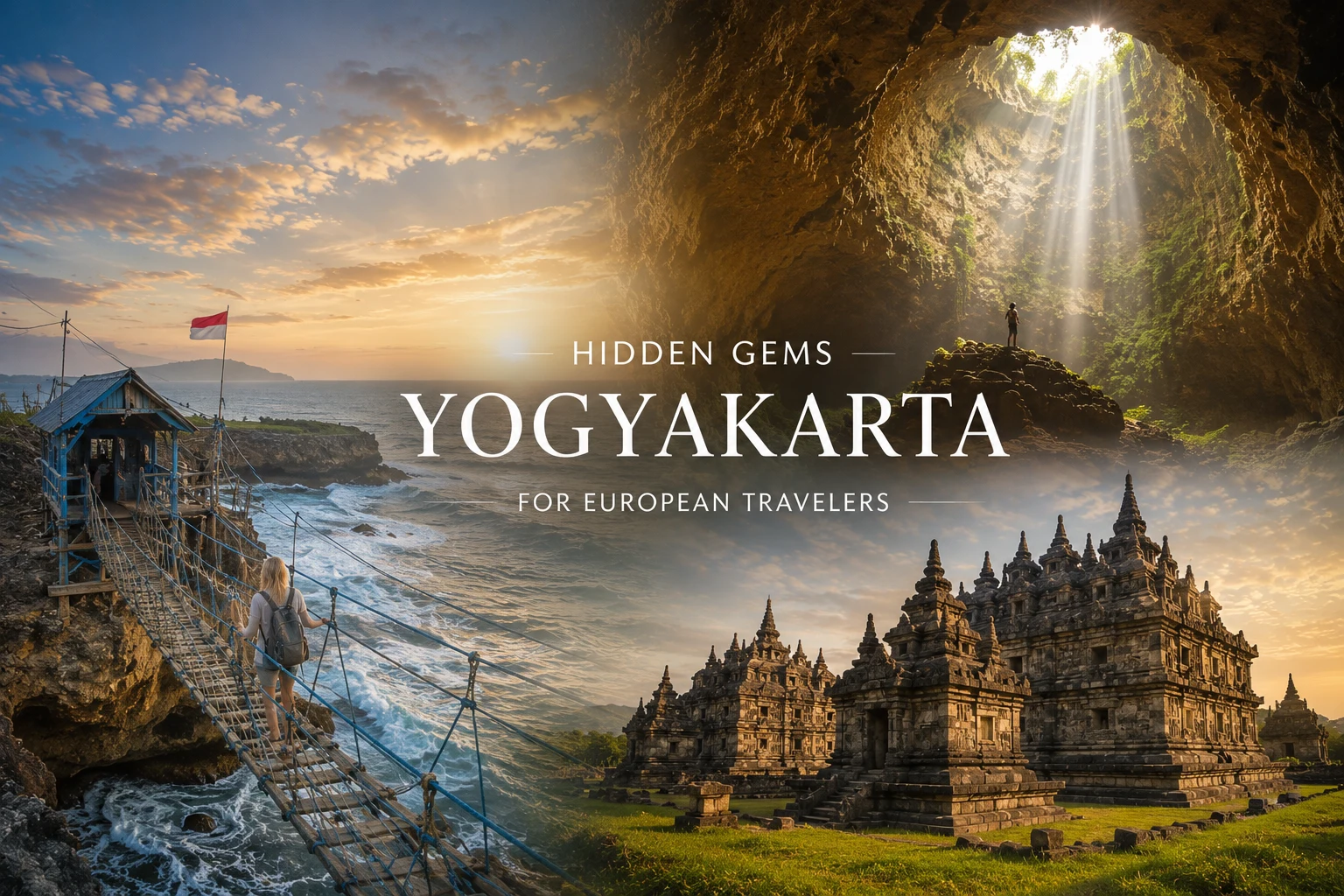

Most European travelers arrive in Yogyakarta with the same list: Borobudur on day one, Prambanan on day two, and Malioboro somewhere in between. That list is fine. Those places are extraordinary.
But Yogyakarta’s region is enormous, and the things that tend to stick with travelers long after the trip — the stories they tell when they get home — are usually the places that weren’t on the list at all. This is a guide to those places.
Sixty meters below the jungle surface, there is a forest. A real, functioning underground forest, growing in the dark at the bottom of a vertical sinkhole, kept alive by a single beam of sunlight that filters through the cave mouth for a few hours each morning.
The locals call it “Cahaya Surga” — the light of heaven — and photographs of it have circulated widely enough that the cave is well known by name. What’s less well known is how physically remote it feels, and how few people actually make the journey.
Getting into Jomblang requires rappelling down a vertical rope descent with a guide, walking through a 300-meter passage carved through ancient rock, and then waiting for the light.
The experience is capped at a small number of visitors per day, which keeps the atmosphere genuinely quiet. It’s one of those rare places where the photographs, however good, don’t quite capture it.
Located in Gunungkidul, about 90 minutes southeast of Yogyakarta. Wahyu Travel Indonesia includes Jomblang Cave as part of the Jomblang Cave, Pindul Cave & Timang Beach adventure tour.
Timang Beach is not a beach in any conventional sense. There is no swimming, no sunbathing, and no gently lapping waves. What there is instead is a stretch of dramatic limestone cliff over a churning sea, a hand-pulled wooden gondola stretched across open ocean, and a small rocky island where local fishermen have been harvesting lobsters for generations.
The gondola — made entirely of wood and rope, operated by a pulley system — was built for the fishermen. Tourists can ride it now, crossing approximately 100 meters of open water above waves that crash against the rock below.
It’s exhilarating in a way that’s hard to manufacture. The island on the other side has fresh lobster, grilled and served simply, caught the same morning.
For travelers who’ve done the obvious beaches in Bali and want something genuinely different, Timang is the answer. Also in Gunungkidul, about 2 hours from the city.
Where Jomblang is vertical and intense, Pindul is horizontal and meditative. The cave contains an underground river, and visitors explore it on rubber inner tubes, floating slowly through 300 meters of limestone corridor while guides light the stalactite and stalagmite formations above and below the waterline.
The cave is home to a colony of bats, and the rock formations include shapes that locals have named over generations — an elephant, an umbrella, a wayang puppet.
The water is clear and cool, and the experience is surprisingly peaceful given how unusual it is. Suitable for most ages and fitness levels, and often paired with Jomblang in the same day.
Plaosan sits less than two kilometers north of Prambanan, close enough to visit on the same afternoon. It was built in the 9th century, around the same time as its famous neighbors, by a Buddhist king as a gift for his Hindu queen — one of the more poetic gestures in Javanese history.
The twin main temples are connected by a series of smaller shrines, and the entire complex is almost always deserted compared to the crowds at Prambanan.
The carvings at Plaosan are delicate and well-preserved. The setting, surrounded by rice fields with Merapi visible to the north, is one of the most photogenic in the region. Most visitors don’t know it exists. Those who find it tend to say it’s one of the best things they did in Yogyakarta.
The landscape surrounding Prambanan is made for cycling — flat roads, rice paddies, traditional villages, and ancient temples appearing at unexpected intervals along the route.
A half-day bicycle tour from the Prambanan complex takes you through small communities that most tourists drive past without stopping: local warung kitchens, batik workshops, farmers guiding buffalo through paddy fields, and smaller temples like Sambisari (a Hindu temple discovered entirely buried underground in 1966 and excavated over decades).
It’s a completely different pace from the standard temple tour, and one that tends to appeal particularly to travelers who want human contact alongside the monuments. Wahyu Travel Indonesia’s cycling tour around Prambanan connects all of this without requiring any particular fitness level.
Most travelers visit Merapi from the bottom up, via jeep. Fewer take time to explore the broader Kaliurang area — a cool-climate hill town on Merapi’s southern slope that was a Dutch colonial retreat and still carries that atmosphere in its old villas and forested paths.
The Merapi Nature Walking Tour starts here and takes you through volcanic landscapes, jungle trails, and traditional Javanese villages on the mountain’s flank.
The Ullen Sentalu Museum in Kaliurang is one of the finest cultural museums in Java, dedicated to the art and history of Javanese royal culture, and almost never mentioned in standard tourist guides. The combination of mountain air, walking trails, and a genuinely excellent museum makes Kaliurang worth half a day even if you’ve already done the jeep tour.
While most travelers default to Parangtritis — the closest beach to Yogyakarta and consequently the most crowded — the Gunungkidul coastline stretching east of the city is a completely different proposition.
Indrayanti is one of the more accessible of these beaches: a curved bay with turquoise water, limestone cliffs, and a fraction of the crowds you’d find on comparable beaches in Bali.
The road along the Gunungkidul coast connects a series of these bays — Sundak, Drini, Baron, Kukup — each with slightly different character, most with local seafood warungs, and almost none with the commercial infrastructure that defines beach tourism elsewhere in Indonesia. A private car makes it possible to move between several in a single day.
Kalibiru is a forest park on the hills west of Yogyakarta, overlooking the Sermo Reservoir and the valley below. It became famous for a particular photograph — someone standing on a wooden platform in the trees, looking out over green hills and still water — that circulated widely enough to make it recognizable even to people who don’t know its name.
What the photograph doesn’t show is how peaceful the surrounding forest is, or how the view extends on clear days all the way to the southern coast.
It’s about an hour’s drive from Yogyakarta, makes a natural stop on the way to or from Borobudur, and is most beautiful in the morning before cloud cover builds over the hills.
This one is hiding in plain sight. Most visitors to Prambanan arrive in the morning, spend two hours, and leave. A significant number don’t know that during dry season (roughly May through October), an outdoor Ramayana Ballet performance takes place three evenings a week on an open-air stage with the illuminated temple complex as its backdrop.
The Ramayana is the Hindu epic whose narrative is literally carved into the walls of the Prambanan temples — so watching it performed live in front of the stone reliefs that tell the same story creates a kind of layered experience that’s genuinely hard to forget. The performances run Tuesday, Thursday, and Saturday evenings, and tickets need to be arranged in advance.
Candi Mendut sits three kilometers east of Borobudur on the same ancient sacred axis, and it’s almost always empty.
Built in the 9th century, it’s a functioning Buddhist monastery as well as a historical site — monks still use it for ceremonies — and the interior houses three of the finest Buddhist statues in Java: a serene central Buddha flanked by Bodhisattvas, all carved from single stones and far more intimate in scale than anything at Borobudur itself.
Candi Pawon, between Mendut and Borobudur on the same axis, is smaller still — a single tower, beautifully proportioned, usually deserted.
The academic debate about its original function (treasury? funerary temple?) is unresolved, which makes it curiously interesting. Both are within a short drive of the main Borobudur complex and require almost no extra time if you’re already making the trip.
A Note on Getting There
Most of these places are difficult or impractical to reach by public transport. Gunungkidul in particular requires either a private car or a motorbike, and the cave tours involve early starts and coordinated logistics.
A private driver-guide from Yogyakarta resolves all of this — you get door-to-door pickup, local knowledge about conditions (Jomblang’s light depends on weather, Timang’s gondola can be affected by sea conditions), and flexibility to add or adjust stops on the day.
Wahyu Travel Indonesia runs private tours to all of these destinations from Yogyakarta, with English-speaking driver-guides and hotel pickup included. If you want to put together a custom itinerary that combines any of the above, the easiest way is to get in touch directly via WhatsApp.
