
Votre panier est vide.
Excursion au lever du soleil sur le Merapi : le récit sincère d'un novice sur ce à quoi s'attendre
Personne ne vous parle du froid. On vous parle de la jeep, des champs de lave, de la vue sur les cratères à l'aube. Vous…
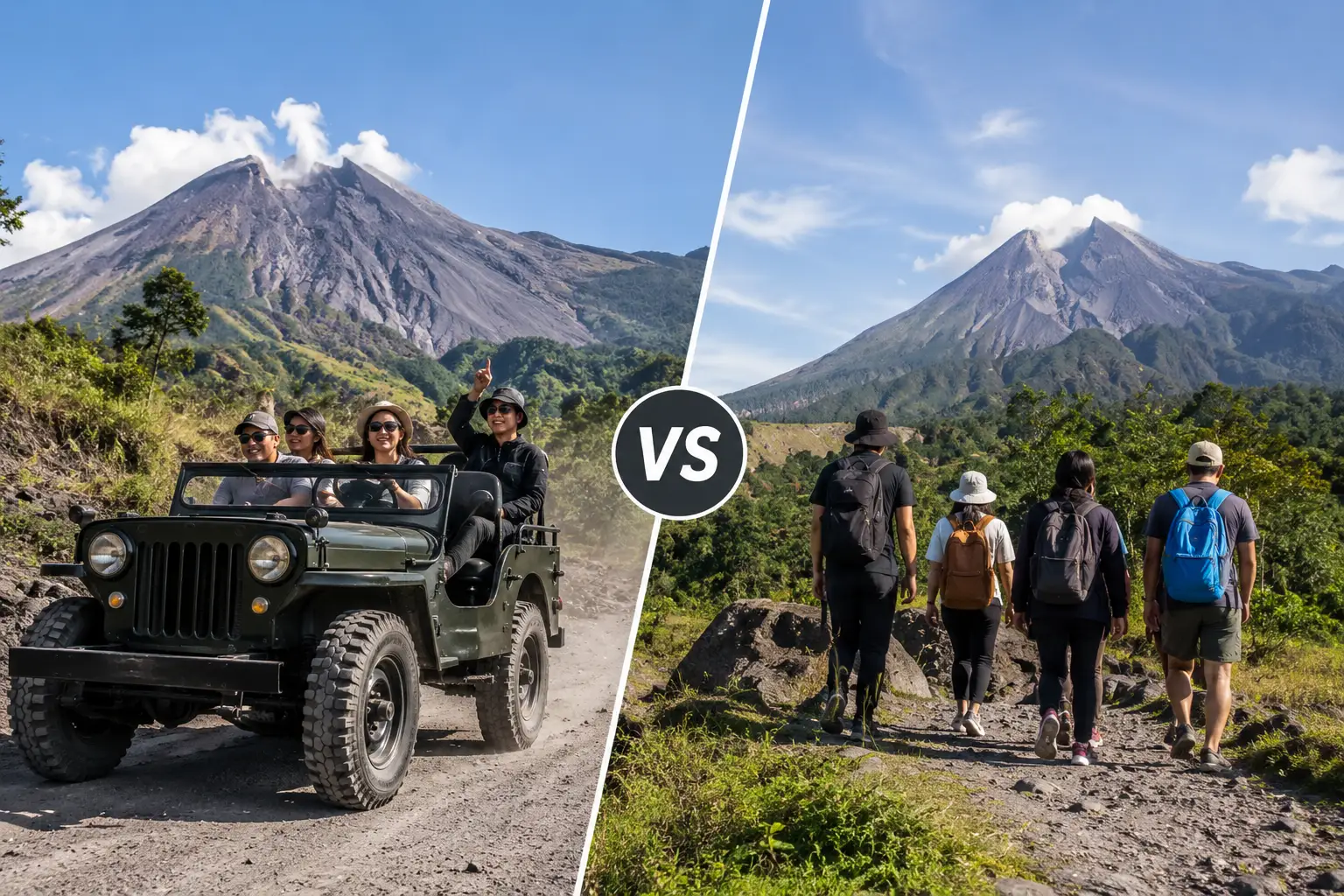

Mount Merapi offers two completely different ways to experience the same volcano. One puts you in an open-top 4×4 jeep tearing through hardened lava fields at speed. The other takes you on foot through forest trails and Javanese villages on the mountain’s quieter slopes.
Both are good. They’re just good in very different ways, and the right choice depends entirely on what kind of traveler you are. This guide breaks down both options honestly so you can decide before you book.
The jeep tour is the more popular of the two options, and for good reason. You’re picked up from your hotel in Yogyakarta, driven north to the Kaliurang area, and transferred into an open-top 4×4 driven by a local who knows every lava path on the mountain.
From there, the tour takes you through the landscape left behind by Merapi’s eruptions, most significantly the catastrophic 2010 event that killed nearly 400 people and buried entire villages under pyroclastic flows.
The key stops on most jeep routes include the Museum Sisa Hartaku, a small memorial museum set inside the ruins of a house destroyed in 2010, with melted motorbikes and warped household items still in place.
Then there’s the Bunker Kaliadem, a concrete emergency shelter that failed to protect two people who sheltered inside during the 2010 eruption. Further along, Alien Rock is a massive boulder displaced by volcanic force. And throughout the route, elevated viewpoints give you clear sightlines toward Merapi’s crater on a good day.
The jeep tour is physical, loud, and fast-paced. It’s best suited to travelers who want adrenaline alongside their history, who don’t mind bumping through volcanic terrain in an open vehicle, and who want to cover as many stops as possible in a few hours. Most routes take between 1.5 and 5 hours depending on the package you choose.
Wahyu Travel Indonesia’s Merapi Jeep & Countryside Walk Experience combines the jeep portion with a slower countryside walk afterward, which is a good way to get both if you only have one day on the mountain.
The walking tour operates out of the Kaliurang area, on Merapi’s southern slopes, and covers a very different kind of terrain. Instead of lava fields and volcanic debris, you’re walking through agroforestry land, village paths, and forested hillsides, with local guides who grew up on this mountain and know its agricultural rhythms as well as its volcanic history.
A typical walking tour lasts 2 to 3 hours on foot and takes you past coffee and cacao plantations, bamboo groves, medicinal herb gardens, and traditional Javanese village homes.
Your guide will stop to explain what’s growing, how the local farming systems work, and the relationship between the communities on Merapi’s slopes and the volcano they’ve lived alongside for generations.
The views of Merapi itself, when the weather is clear, can be as dramatic on foot as from a jeep. The difference is the pace: you’re standing still long enough to actually take them in.
This option doesn’t involve any lava fields or eruption sites. It’s a nature and culture walk, not a disaster tourism experience, and it attracts a different kind of traveler: those who prefer walking to riding, who want genuine community contact over spectacle, and who appreciate a slower, quieter version of the same landscape.
For physical intensity, the jeep tour wins on adrenaline but the walking tour requires more sustained effort on foot. Neither is extreme, but they’re very different kinds of exertion.
For historical content, the jeep tour has the edge. The Museum Sisa Hartaku, Bunker Kaliadem, and the visible lava landscape are deeply affecting stops that tell a specific story about the 2010 eruption in concrete, human terms.
For cultural depth, the walking tour goes further. Spending two hours walking through an active farming community with a local guide produces a different kind of understanding than driving past the same landscape at speed.
For photography, both are strong but in different ways. The jeep tour gives you dramatic volcanic terrain, wide-angle lava field shots, and the bunker. The walking tour gives you soft morning light through forest canopy, close-up detail of local plants and traditional homes, and unposed interactions with villagers.
For families with children, the walking tour is easier to manage. The jeep is bumpy enough that it can be uncomfortable for young kids or anyone with back problems.
Choose the jeep tour if you want a high-intensity, historically rich experience that covers a lot of ground quickly, if you’re interested in the 2010 eruption and its aftermath, or if you’re combining Merapi with other Yogyakarta stops in the same day and need an efficient morning option.
Choose the walking tour if you prefer a slower pace, want genuine connection with local communities and landscapes, or are traveling with people who would find a long bumpy jeep ride uncomfortable.
Choose both if you have the time. Wahyu Travel Indonesia’s Merapi Jeep & Countryside Walk Experience does exactly this, pairing the jeep lava tour with a guided countryside walk through the villages above Kaliurang. It’s a longer day, but it gives you a complete picture of what Merapi’s slopes actually hold.
For the jeep tour, bring a dust mask or buff, closed-toe shoes, sunglasses, and more water than you think you need. The volcanic terrain is dry and exposed, and the jeep kicks up a lot of fine ash on dry days.
For the walking tour, wear comfortable walking shoes, bring a light jacket for the early morning cool, and be prepared for uneven paths through farmland. The terrain is gentler than it sounds but not entirely flat.
Both tours depart from the Kaliurang area, roughly 25 kilometers north of central Yogyakarta. Hotel pickup from the city is standard with most private operators, including Wahyu Travel Indonesia.
See the Merapi Jeep Lava Tour packages →|| See the Merapi Jeep & Countryside Walk Experience →
