
No hay productos en el carrito.
Excursión al amanecer al Merapi: el relato sincero de alguien que va por primera vez sobre qué esperar
Nadie te habla del frío. Lees sobre el todoterreno, los campos de lava, las vistas del cráter al amanecer. Tú…
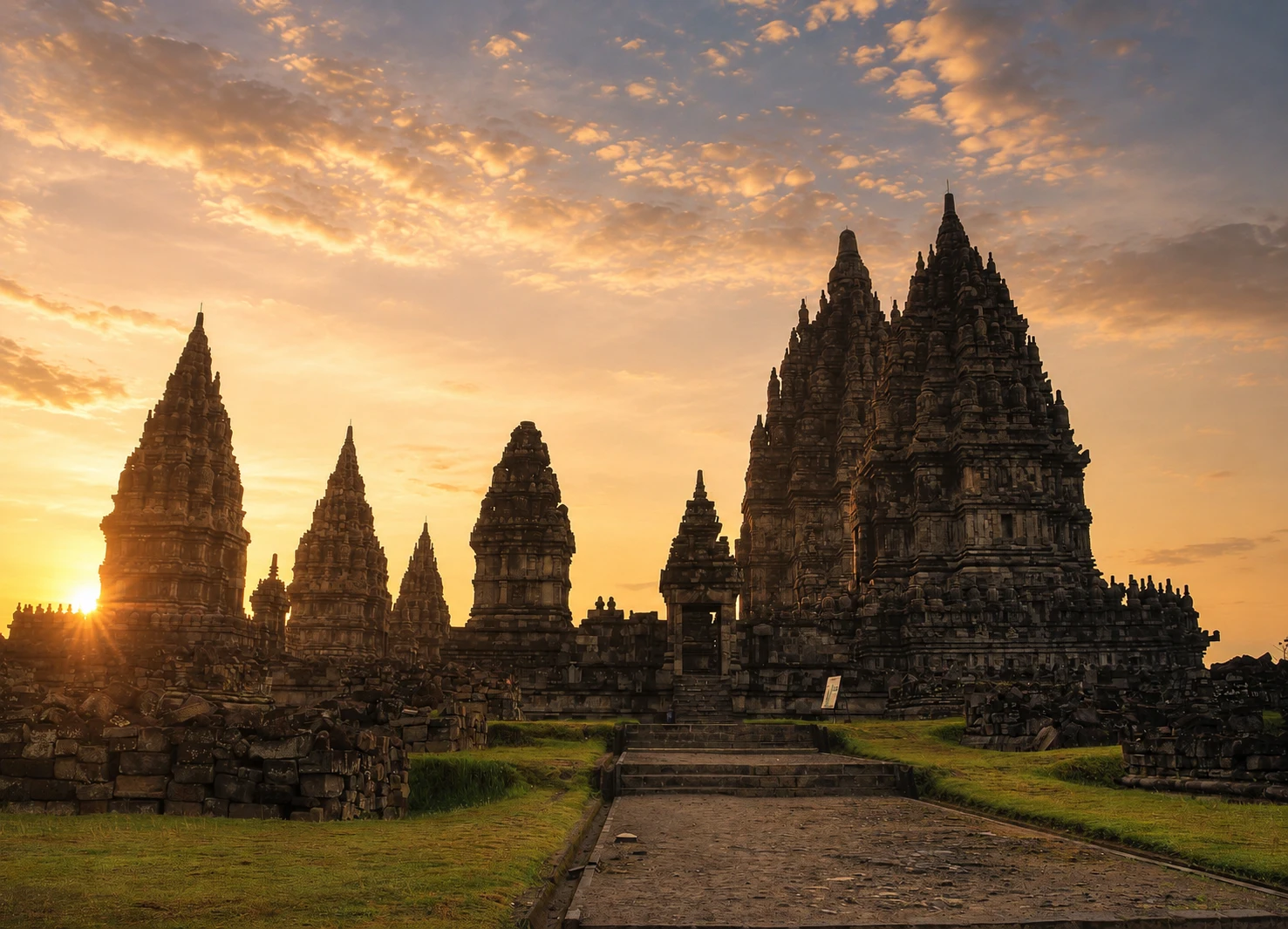

If Borobudur is Java’s most famous temple, Prambanan is its most dramatic. Where Borobudur spreads wide and contemplative across a forested hill, Prambanan shoots upward — three central towers rising 47 meters into the sky, sharp and symmetrical against the open plains east of Yogyakarta. The effect, especially in the late afternoon when the stone catches the golden light, is genuinely breathtaking.
Prambanan is a 9th-century Hindu temple complex dedicated to the Trimurti — Brahma the Creator, Vishnu the Preserver, and Shiva the Destroyer.
It was built around the same time as Borobudur, just a few decades apart, which makes the fact that both monuments exist within 45 kilometers of each other remarkable. Two of the greatest religious structures in Southeast Asian history, built by the same civilization, one Buddhist and one Hindu, sitting side by side on the same stretch of Javanese plain.
This guide covers everything you need to plan your visit: tickets, the best time to go, what to see inside the complex, practical tips, and how to combine Prambanan with Borobudur in a single day.
Prambanan is the largest Hindu temple complex in Indonesia and one of the finest examples of classical Hindu architecture in Southeast Asia. The full complex originally contained 240 temples, though most have collapsed over centuries of earthquakes and neglect. What remains are eight main temples, restored and standing, surrounded by the ruins of hundreds of smaller shrines.
The three central towers are dedicated to the Trimurti. The tallest, at 47 meters, is the Shiva temple at the center. Flanking it are the Brahma temple to the south and the Vishnu temple to the north, each around 33 meters tall.
Across from each main temple stands a smaller shrine housing the sacred vehicle (vahana) of each deity — Nandi the bull for Shiva, Hamsa the goose for Brahma, and Garuda the eagle for Vishnu.
The walls of all three main temples are covered in intricate carvings. The most famous are the Ramayana reliefs that run along the inner gallery of the Shiva temple — a continuous stone narrative of the epic Hindu poem that stretches across more than 100 panels. UNESCO designated Prambanan a World Heritage Site in 1991.
The dry season from May to October is the most comfortable time to visit. The skies are clearer, the light is better for photography, and you avoid the heavy rain that can make the open grounds muddy and the stone surfaces slippery.
That said, Prambanan is open year-round and worth visiting in any season. The grounds are largely exposed, so the afternoon sun can be intense between November and April when the humidity is higher. Aim for early morning or late afternoon regardless of when you go.
By time of day, early morning (opening time at 8:00 AM) gives you the best chance of beating tour groups. Late afternoon, from around 3:00 PM onward, is the other sweet spot — the light becomes golden and warm, the crowds thin out, and the towers look their most striking. Some visitors combine a late afternoon entry with the evening Ramayana Ballet performance, which is held outdoors with the temple as its backdrop during dry season. That combination makes for a genuinely memorable evening. Prambanan is closed on Mondays.
The standard entry ticket for international visitors costs approximately IDR 400,000 per adult. This covers access to the main Prambanan complex including all eight restored temples and the surrounding grounds.
There is also a combined ticket with Borobudur available at approximately IDR 750,000, which covers ground-level access to Borobudur (not the structure climb) and full access to Prambanan. If you’re planning to visit both on the same day, this can save some money, though you’ll need to weigh it against the separate Borobudur Structure Ticket if climbing the temple is a priority for you.
The Ramayana Ballet performance tickets are sold separately. During dry season (roughly May to October), performances are held outdoors on the open-air stage directly in front of the temple complex, usually on Tuesday, Thursday, and Saturday evenings. In wet season, performances move to an indoor theater nearby. Check current schedules before you go, as performance days can change.
Prambanan sits about 17 kilometers east of central Yogyakarta, right on the border between Yogyakarta and Central Java provinces. It’s the closer of the two major temples to the city, and there are several ways to get there.
The most comfortable option is a private driver or tour, especially if you’re combining Prambanan with Borobudur or other stops in the same day. You get door-to-door pickup, no parking logistics to deal with, and a guide who can explain what you’re looking at once you’re inside.
Wahyu Travel Indonesia includes Prambanan as part of several private day tour packages from Yogyakarta — either as a standalone city tour combination or as part of a full-day temple circuit with Borobudur.
For independent travelers, the TransJogja public bus is a practical option. Line 1A and 1B both stop at Prambanan, and the journey takes around 45 minutes to an hour from the city center depending on traffic. The fare is around IDR 3,500 — genuinely one of the cheapest ways to travel between Yogyakarta attractions. The stop is close to the main entrance.
Grab and Gojek (Indonesia’s ride-hailing apps) are another solid option, usually running around IDR 30,000–50,000 one way from central Yogyakarta depending on traffic and time of day.
Once you’re inside the gates, the scale of the site becomes clear. The main compound is large, and most visitors focus on the three central towers, but there’s more to see if you take your time.
The Shiva Temple in the center is where most people spend the majority of their time. The interior chamber holds a large statue of Shiva, and the Ramayana reliefs along the outer gallery are extraordinary — carved in continuous sequence, they follow the story of Prince Rama, his wife Sita, and the demon king Ravana across panel after panel. A guide will help you follow the narrative, because without context the carvings are beautiful but the story is easy to miss.
The Brahma Temple to the south continues the Ramayana story where the Shiva temple leaves off. The Vishnu Temple to the north depicts scenes from the Krishnayana, a narrative cycle about the life of Krishna.
Beyond the three main towers, it’s worth walking through the wider grounds where hundreds of smaller temples (called perwara temples) once stood. Most are in varying states of ruin — some restored to their lower courses of stone, others just foundations. The atmosphere in this outer area is quieter, and you get a better sense of the original scale of the complex.
Just outside the main Prambanan compound, about a 15-minute walk or a short drive north, is Candi Sewu — a Buddhist temple complex of nearly 250 structures, the second largest Buddhist temple in Indonesia after Borobudur.
It’s often skipped by visitors who don’t know it’s there, which means it’s usually quiet. If you have an hour to spare, it’s worth adding.
Yes, and this is the itinerary most first-time visitors to Yogyakarta choose. The two temples sit in opposite directions from the city — Borobudur roughly 40 kilometers northwest and Prambanan 17 kilometers east — so a private driver is the easiest way to coordinate both without spending half the day on logistics.
The standard approach is to leave Yogyakarta early (by 7:00–7:30 AM), visit Borobudur first while it’s cooler, have lunch somewhere along the way back toward the city, then continue east to Prambanan for the afternoon. This gives you 2–3 hours at each temple without feeling rushed, and you’re back in Yogyakarta by evening.
Wahyu Travel Indonesia Yogyakarta City Tour & Prambanan Temple package covers this itinerary with hotel pickup, English-speaking driver-guide, and flexible timing — so if you want to spend longer at one site or add a stop along the way, that’s easy to arrange.
Yes, why not? — and it’s worth it even if you’ve already visited Borobudur on the same trip, because the two are so different that they don’t compete with each other. Borobudur is meditative and horizontal, a Buddhist monument built for contemplation. Prambanan is vertical and dramatic, a Hindu complex built to assert spiritual power. Seeing both in the same day gives you something that neither temple alone can: a real sense of what 9th-century Java was, and how much it produced.
The Ramayana reliefs alone justify the visit. So does the Ramayana Ballet, if you can catch an evening performance. So does the late afternoon light hitting the central towers just before sunset. Give it the time it deserves.
Wahyu Travel Indonesia is a Yogyakarta-based private tour operator offering dedicated Prambanan tours and full-day temple circuits across Java, with English-speaking driver-guides and hotel pickup included. Whether you want Prambanan on its own or as part of a combined day with Borobudur and the city, we handle the planning so you can focus on the temples.
