
No hay productos en el carrito.
Excursión al amanecer al Merapi: el relato sincero de alguien que va por primera vez sobre qué esperar
Nadie te habla del frío. Lees sobre el todoterreno, los campos de lava, las vistas del cráter al amanecer. Tú…

About three kilometers from Borobudur, tucked into the landscape at the base of Mount Merapi’s southern slope, sits a village that has spent the last few decades doing something unusual: deliberately keeping things the way they were.
Candirejo is a traditional Javanese village that made a conscious decision to preserve its agricultural systems, its community practices, and its way of life as the region around it modernized. The name itself gives you a hint — “Candi” means stones or rocks in Javanese, “Rejo” means fertile. A fertile rocky village, at the foot of a volcano. That’s exactly what it is.
Most village tours in Indonesia follow a similar format: drive through, stop for a photo, watch a craft demonstration, leave. Candirejo is structured differently.
The village operates as a community-based tourism initiative, which means the people you meet along the route — farmers, craftspeople, families — actually live there. Nothing is staged for the tour.
The agricultural system practiced in Candirejo is what’s called multi-cropping, where different crops grow together in the same field rather than the monoculture approach used in most commercial farming.
Walking or riding through the village, you’ll see rice, cassava, corn, tropical fruits, and herbs growing alongside each other. Farmers often invite visitors to participate in whatever’s happening at that moment, whether planting, harvesting, or preparing soil, depending on the season.
The village also still maintains traditional Javanese cultural practices that are harder to find in more urbanized parts of the region — gamelan music, traditional crafts like pottery and cassava cracker making, and the kind of unhurried daily rhythm that feels genuinely different from both the city and the tourist trail.
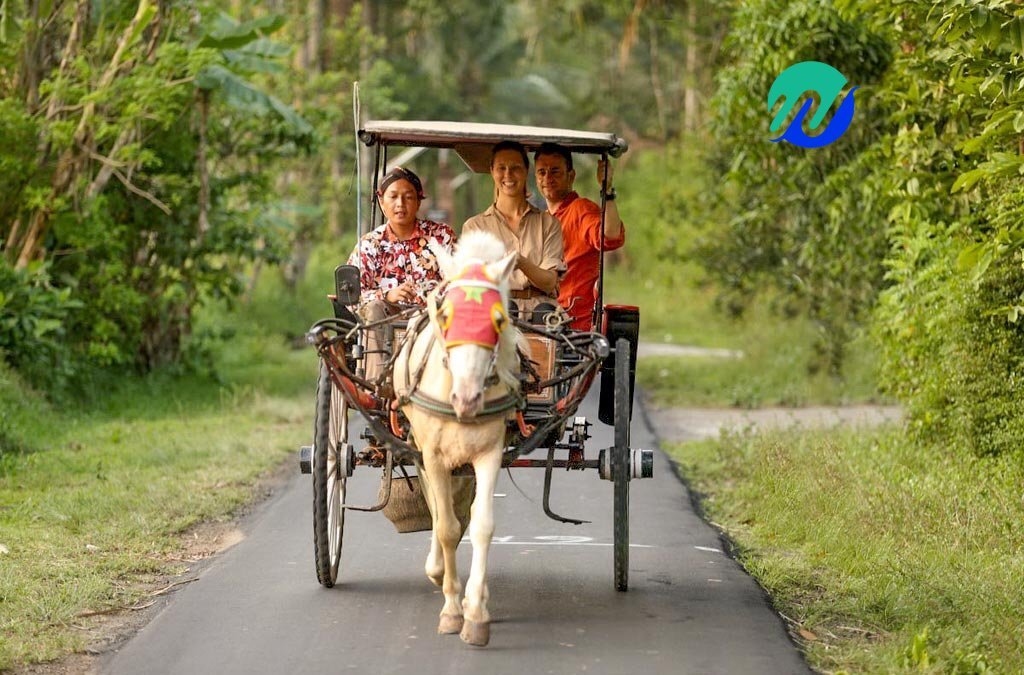
The main way to explore Candirejo is by andong, a traditional two-wheeled horse carriage that has been used in Java for centuries. You sit in the carriage with your guide, and the horse takes you along the village paths and through the agricultural land surrounding it, stopping at points of interest along the route.
It’s slow, deliberately so. The pace of an andong matches the pace of the village — you have time to look at what’s around you, to stop when something is happening in the fields, and to have actual conversations with locals rather than driving past them.
Reviews from travelers who’ve done it consistently mention being surprised by how unhurried and human the experience feels compared to standard tour formats.
The ride itself typically lasts one to two hours. The carriage holds a small group, the horses are well-maintained, and the paths through the rice fields are genuinely scenic, with Merapi visible in the distance on clear days and the green of the volcanic agricultural landscape in every direction.
Some tours offer cycling as an alternative to the horse carriage on the same route, which is worth considering if you’d rather cover the ground on your own pace and effort.
Beyond the carriage ride, Candirejo visits typically include stops at local workshops where you can watch or participate in traditional crafts. Cassava cracker making is a common one, and pottery workshops are available at certain points in the year.
Gamelan instruments are often on hand for visitors who want to try playing them, and local families sometimes host simple cooking demonstrations using produce from the village fields.
The experience is participatory in a way that temple tours aren’t. You’re not looking at something behind a barrier — you’re in the middle of it, and the people around you are going about their actual lives.
Given the village’s location three kilometers from Borobudur and on Merapi’s southern approach, it fits naturally into a combined day. A common itinerary is Merapi jeep lava tour in the early morning, then Candirejo village by horse carriage in the late morning, then Borobudur in the afternoon.
It’s a long day but a varied one, and the contrast between volcanic off-road terrain and slow village life in the same morning is part of what makes it memorable.
Wahyu Travel Indonesia Merapi Off-Road Adventure, Candirejo Village Tour & Cycling covers this exact combination, with hotel pickup from Yogyakarta and an English-speaking driver-guide for the full day.
The village is accessible year-round. Wet season makes the agricultural landscape greener and more dramatic, though some paths can get muddy. Dry season (May to October) is more comfortable for the carriage ride and cycling.
There’s nothing particularly physical required — the andong does the work. Wear comfortable clothing, bring sunscreen for the open sections of the route, and if you’re interested in the craft workshops, just let us know in advance so one of our guide can confirm availability.
