
No products in the cart.
Merapi Sunrise Tour: An Honest First-Timer’s Account of What to Expect
Nobody tells you about the cold. You read about the jeep, the lava fields, the crater views at dawn. You…
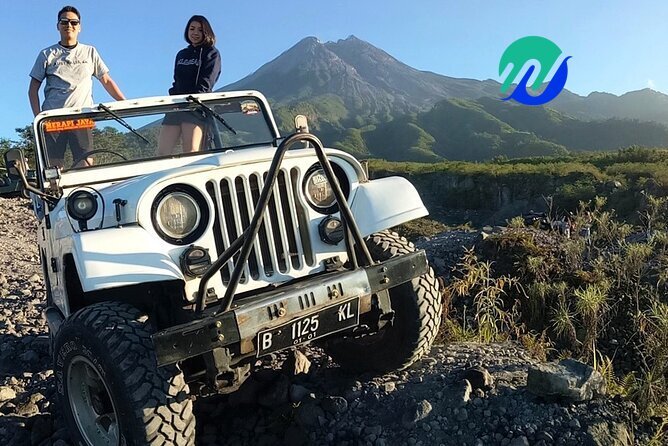

Most people book the Merapi lava tour knowing two things: there’s a jeep, and there’s a volcano. What they don’t always know is what they’ll actually see once they’re out there, which stops matter, what the story is behind each one, and which route gives them the most for their time.
This guide runs through every main stop on the Merapi lava tour, from the most common short route to the longer options that go deeper into the mountain’s history.
The Merapi lava tour runs out of the Kaliurang area, roughly 25 kilometers north of Yogyakarta city. All tours use open-top 4×4 jeeps driven by local guides, and all tours operate within officially designated safe zones away from the volcanic exclusion area.
There are three standard route lengths. The short route (1 to 1.5 hours) covers three or four stops. The medium route (2 to 2.5 hours) adds the Kali Kuning river crossing. The long route (3.5 to 5 hours) goes furthest up the mountain and includes stops that most short-route visitors never reach, including Mbah Maridjan’s former home.
All routes share the same core stops, which are described below in the order most tours follow them.
Almost every Merapi lava tour starts here, and it tends to be the stop that hits hardest. Museum Sisa Hartaku translates roughly as “the remains of my possessions.” The name is accurate. The museum is a civilian house that was engulfed by pyroclastic flows during the 2010 eruption, and what’s inside are the objects that survived in damaged form: motorcycles melted into unrecognizable shapes, kitchen equipment fused together by heat, household items coated in ash and volcanic debris.
There are animal skeletons. There are photographs showing the eruption and its aftermath. There is a room explaining Merapi’s eruptive history in more detail.
It’s not a large space, and it’s not a polished museum. That’s exactly what makes it affecting. Everything in there belonged to someone who lived here, and the scale of destruction is visible in the most ordinary objects.
Plan for 20 to 30 minutes here. Most guides will explain the history of the 2010 eruption and the family who owned the house before moving on.
A short jeep ride from the museum brings you to Batu Alien, a large boulder sitting in the middle of the volcanic landscape, named for the shape on its surface that resembles a human face.
The rock was displaced by the force of the 2010 eruption, carried down the mountain and deposited where it now sits.
It’s a photo stop as much as anything else, and your guide will position you for the best angles. The surrounding landscape is worth paying attention to here too: hardened grey lava fields stretching in multiple directions, the mountain visible above when the weather is clear, and the strange silence of terrain that used to be forest and farmland.
This is the stop that tends to stay with people longest. Bunker Kaliadem is a concrete emergency shelter built into the hillside a few kilometers from Merapi’s crater. It was constructed as a refuge for people who couldn’t evacuate quickly enough when the volcano became active. During the 2010 eruption, two people used it.
The pyroclastic flows, moving at temperatures of several hundred degrees, breached the shelter. Both people inside died.
The bunker is open to visitors. You can descend the steps into the interior, which is dark, low-ceilinged, and still scarred by heat. There’s nothing dramatic staged inside. The weight of the place comes from understanding what it was meant to do and what happened when it failed.
Outside the bunker, there are usually souvenir sellers and a clear sightline toward Merapi’s summit. On a good day, you can see the crater rim and, if Merapi is active, a plume of volcanic gas rising from the top.
Included in the medium and long routes, the Kali Kuning river crossing is where the jeep tour becomes most physically adventurous. The driver takes the jeep down into a dry volcanic riverbed and crosses it, sometimes through shallow water depending on the season.
Kali Kuning was one of the main lava flow paths during the 2010 eruption. The riverbed is still filled with volcanic sediment, and the banks on either side show the layers of material deposited over multiple eruptions. When you’re standing in it, the scale of what flows down this channel during an eruption becomes very tangible.
Most guides stop here for photographs before crossing and heading to the next stop.
On the longer routes, the tour continues to Kinahrejo, a village about 4 kilometers from the center of the 2010 eruption and one of the hardest hit areas.
Here, you visit the former home of Mbah Maridjan, Merapi’s official gatekeeper (Juru Kunci), a role assigned by the Sultan of Yogyakarta to serve as the mountain’s spiritual guardian.
When the 2010 eruption began and evacuation orders were issued, Mbah Maridjan refused to leave. He was found dead near his prayer mat after the pyroclastic flows passed through. His decision divided opinion at the time and still does, but his story is inseparable from Merapi’s history and the relationship between Javanese culture, spiritual belief, and the volcano.
His house has been preserved as a memorial and small museum, and the stop adds a layer of human and cultural context that the lower stops don’t quite reach.
Throughout the tour, your guide will stop at several elevated points with clear sightlines toward the summit. The quality of these views depends almost entirely on weather.
In dry season, particularly June through August, clear views of the crater and upper slopes are common. In wet season or on cloudy mornings, Merapi can disappear entirely into the clouds.
Sunrise tours, which depart Yogyakarta around 4:00 to 4:30 AM, reach these viewpoints as the sky begins to lighten, and on clear days the mountain lit in early morning gold is the visual most associated with the Merapi tour experience. Wahyu Travel Indonesia’s Merapi Sunrise 4×4 Jeep Lava Tour is built around exactly this timing.
The short route is fine if you’re combining Merapi with other stops in the same day and time is limited. You’ll see the museum, Alien Rock, and the bunker, which are the three stops with the most historical weight.
The medium route adds the Kali Kuning crossing, which makes the jeep experience feel more complete and gives you a better sense of the volcanic landscape.
The long route is for anyone who wants the full picture: the human story of Mbah Maridjan, deeper into the mountain, and more time at each stop. It works best as a standalone morning activity rather than part of a packed day.
Wahyu Travel Indonesia offers Merapi lava tours across all route lengths, with English-speaking driver-guides and hotel pickup from Yogyakarta.
See the Merapi 4×4 Jeep Lava Tour → | See the Merapi Sunrise Jeep Tour →
