
No products in the cart.
Merapi Sunrise Tour: An Honest First-Timer’s Account of What to Expect
Nobody tells you about the cold. You read about the jeep, the lava fields, the crater views at dawn. You…
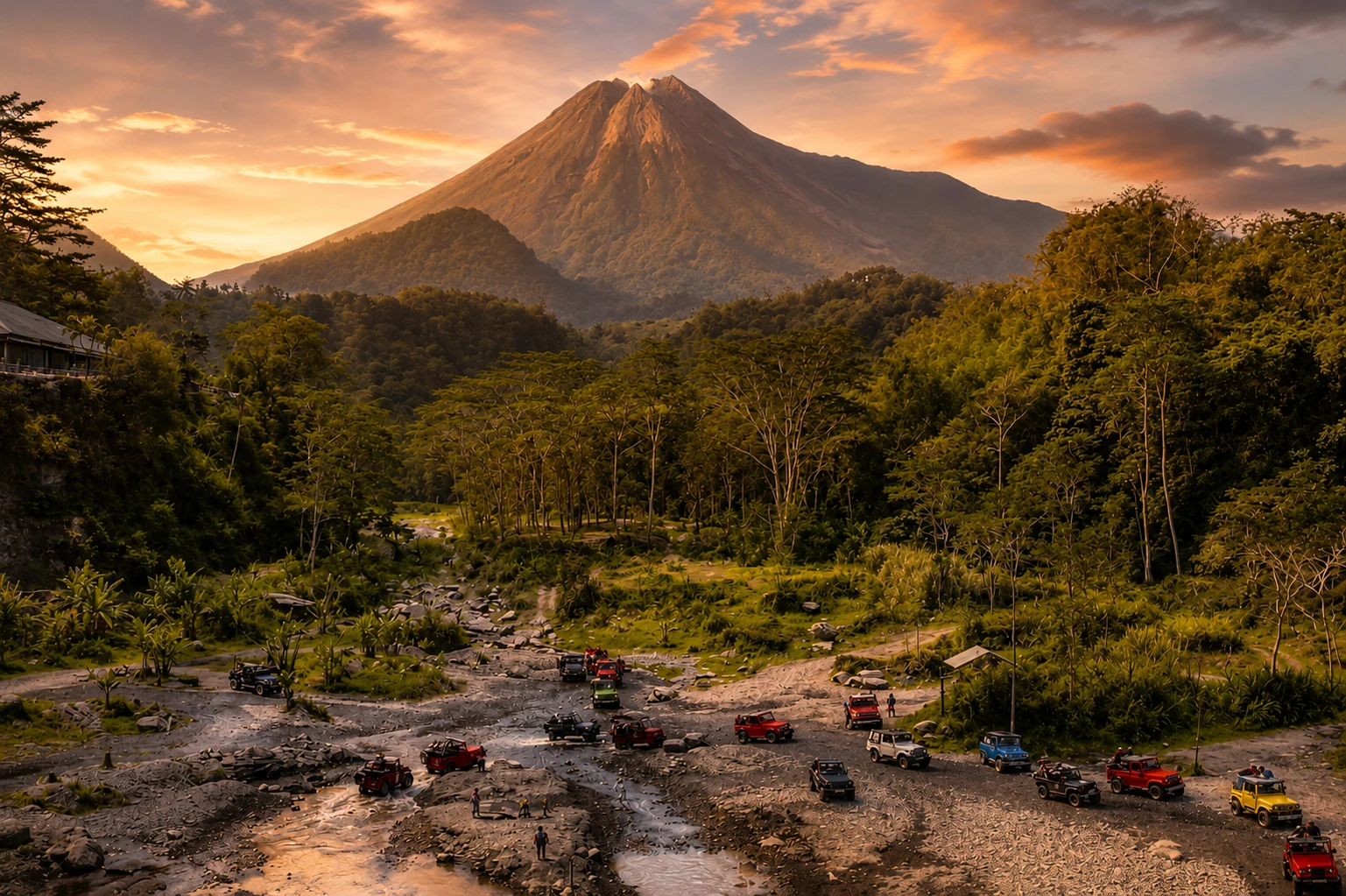

Mount Merapi is one of the most active volcanoes on Earth. It sits just 28 kilometers north of Yogyakarta, close enough that on a clear morning you can see it from the city streets. A dark, perfectly formed cone rising above the rooftops, occasionally trailing a thin thread of smoke is what Merapi famous for.
Most travelers come to Yogyakarta for the temples. But many of them end up saying the Merapi jeep tour was the thing they didn’t expect to love as much as they did.
This guide covers everything you need to know before you go: what the tour actually involves, sunrise versus daytime, how much it costs, what to bring, and why going with a local guide makes all the difference.
The Merapi Lava Tour is an off-road jeep adventure through the volcanic landscape north of Yogyakarta, the same terrain reshaped by Merapi’s major eruptions, most dramatically in 2010, when pyroclastic flows killed nearly 400 people and forced the evacuation of over 350,000.
Today, those same slopes have become one of the most unique tour experiences in Indonesia. You ride in an open-top 4WD jeep through hardened lava paths, dry riverbeds, and the remnants of villages that were buried under volcanic ash. Your driver and guide grew up near this mountain. They know its moods, its history, and the stories of the communities who rebuilt here.
It’s part adventure, part history lesson, and entirely unlike anything else you’ll do in Yogyakarta.
This is the first question most travelers ask, and the honest answer is: it depends on what kind of experience you’re after.
The jeep reaches the viewpoints just as the sky begins to lighten. On a clear morning, you’ll see Merapi’s summit lit in shades of orange and gold, the surrounding valleys still dark below. The temperature is cooler, the dust is lower, and there are significantly fewer people on the trails.
The tradeoff is the early start. You’ll be picked up well before dawn, which means an early night if you want to actually enjoy it. And weather is less predictable in the early hours — cloud and fog are common, especially outside the dry season.
That said, if the skies cooperate, it’s genuinely one of the best things you can do in Yogyakarta. Photographers especially tend to prefer this option.
More relaxed timing, better visibility in most seasons, and you don’t have to sacrifice your evening to be functional in the morning. The landscape looks different in full daylight — the textures of the lava fields and ash valleys come through more clearly, and the stops at the museum and bunker are easier to navigate.
The downside is heat. By 10–11 AM the sun is strong, and there’s very little shade on the volcanic terrain. Starting earlier in this window is always the better call.
Our recommendation: If you’re visiting during dry season (May to October) and you’re comfortable with an early start, go for sunrise. For everyone else, a 7:00–8:00 AM departure hits the sweet spot.
Routes vary slightly by operator and package duration, but most Merapi tours in Yogyakarta cover some version of the following:
The jeep descends into a dry riverbed and drives through it. When the river runs with volcanic sediment after rain, the surface looks like grey sand. When it’s dry, the landscape feels almost lunar.
A small museum set up inside the ruins of a house destroyed in the 2010 eruption. Melted motorbikes, warped household items, and personal belongings preserved under volcanic debris. More affecting than you might expect.
A concrete emergency shelter built into the hillside, located just a few kilometers from Merapi’s summit. During the 2010 eruption, two people sheltering here were killed by pyroclastic flows that breached the structure. It’s sobering, quiet, and worth the stop.
A large boulder displaced by the volcanic force, named for its unusual shape. Good photo opportunity, and the guide will tell you exactly how it got there.
Multiple stops at elevated points with clear sightlines to the summit. On a good day you can see the crater rim and, if Merapi is active, a column of volcanic gas or ash rising from the top.
Merapi jeep tours are operated by local jeep communities in the Kaliurang area, typically priced per jeep (not per person), with a maximum of four passengers per vehicle.
Most packages fall into three route lengths:
Covers the main river crossing and a couple of stops. Good for travelers with limited time or young children. ~IDR 350,000–400,000 per jeep.
The most popular option. Covers the museum, bunker, viewpoints, and river. ~IDR 450,000–550,000 per jeep.
Adds additional viewpoints, further off-road trails, and sometimes a visit to Mbah Maridjan’s grave (the famous gatekeeper of Merapi who refused to evacuate in 2010 and died during the eruption). ~IDR 550,000–650,000 per jeep.
typically carry a premium of IDR 100,000–200,000 over the standard daytime rates for the same route.
When you book through Wahyu Travel Indonesia, hotel pick-up from Yogyakarta is included, your driver speaks English, and the itinerary can be combined with other Yogyakarta tours on the same day.
You’ll be walking on uneven volcanic terrain. Sandals are not a good idea here. If you have something more like a hiking sneaker, that would be better.
The jeep kicks up a lot of volcanic dust, especially on dry days. Bring one or pick one up in Yogyakarta before you go.
Essential both for the dust and the glare off the pale lava fields. Yogyakarta is a very hot city, so sunglasses should be helpful.
Even during the day, the higher elevations can be surprisingly cool in the early morning. For sunrise tours especially, it gets cold before the sun comes up.
Bring more than you think you need. There’s not much available on the route. Otherwise you have to wait until the tour is over to buy a bottle of water.
The landscape rewards good photography — wide shots of the lava fields, close-ups of the melted museum pieces, portraits against the volcano background. Your guide will often know exactly where to position you for the best light.
Don’t skip the museum. It’s easy to treat it as a quick box to tick, but the Museum Sisa Hartaku is genuinely moving. Spend some time in it.
Watch the weather the night before. Local guides use a simple heuristic: if it rains the night before, the next day is usually clear. If the night is cloudy with no rain, there’s a higher chance of morning fog. Not a guarantee, but useful.
Book through a local operator. The jeep community in Kaliurang is well-organized and safety-conscious. Avoid random fixers near the tourist areas and book through a trusted local operator who can confirm the driver and route in advance.
Merapi is an active volcano. Tours operate within officially designated safe zones, and eruption monitoring is constant. Reputable operators follow BPPTKG (the national volcanology agency) updates and will reschedule if conditions change. This is not something to worry about — it’s something to trust your operator to handle.
Yes, and it works well. The Merapi jeep tour typically finishes by 9:00–11:00 AM depending on which package you choose, which leaves the rest of the day available for Prambanan Temple, the Kraton (Sultan’s Palace), or Malioboro Street.
Wahyu Travel Indonesia offers a full-day package that pairs the Merapi Sunrise Jeep Tour with Borobudur and Prambanan — one of the most complete Tour Merapi Yogyakarta experiences possible in a single day. It’s a long day, but travelers who’ve done it tend to say it was the best day of their trip. See the Merapi Sunrise, Borobudur & Prambanan Tour.
Yes, when booked through a reputable operator. The jeep routes are within designated tourism zones, well away from the volcanic exclusion area. Drivers are local, experienced, and familiar with the terrain in all conditions.
The bigger safety consideration is the jeep ride itself — it’s genuinely bumpy. Hold on, don’t stand up on the moving vehicle, and if you have a bad back, opt for a shorter route.
Wahyu Travel Indonesia is a Yogyakarta-based private tour operator offering Merapi jeep tours with English-speaking driver-guides, flexible departure times, and hotel pick-up across the city. Whether you want sunrise, daytime, or a full-day combined itinerary, we’ll sort the logistics so you can focus on the mountain.
